Ultrapure water and distilled water are both high-purity water types, but they differ significantly in purification principles, impurity levels, and application scenarios. While both remove contaminants, their distinct processes result in varying degrees of purity—making them unsuitable for interchangeable use. Below is a detailed breakdown of their key differences.
The fundamental difference lies in how each water type achieves purity, as their methods target different contaminants.
- Distilled Water: Produced via distillation, a process that heats water to boiling, collects the steam (which leaves behind non-volatile contaminants like minerals, salts, and solids), and condenses the steam back into liquid. It primarily removes inorganic salts, heavy metals, and particulate matter but is less effective at eliminating volatile impurities (e.g., organic solvents, some bacteria) that vaporize with water.
- Ultrapure Water: Created through a multi-step purification process (typically combining reverse osmosis, ion exchange, ultrafiltration, and activated carbon filtration). This system targets nearly all contaminants: inorganic ions, organic compounds, bacteria, viruses, endotoxins, and even dissolved gases. Unlike distillation, it uses physical and chemical separation to achieve extreme purity, rather than relying solely on heat and condensation.
Their purification methods directly lead to vast differences in residual impurities, measured by parameters like resistivity and total organic carbon (TOC).
- Distilled Water: Has moderate purity, with a resistivity of around 1–5 megohm-centimeters (MΩ·cm) at 25°C. It still contains trace amounts of volatile organics, dissolved gases (e.g., oxygen, carbon dioxide), and some ions that evaporate with steam. TOC levels are usually between 10–100 parts per billion (ppb), making it impure for applications requiring minimal organic contaminants.
- Ultrapure Water: Achieves near-absolute purity, with a resistivity of 18.2 MΩ·cm (the theoretical maximum for pure water at 25°C). Its TOC levels are below 5 ppb, and it contains almost no bacteria, endotoxins, or particles larger than 0.2 micrometers. This extreme purity meets the strictest standards for sensitive experiments and industrial processes.
Due to their varying purity, the two water types serve distinct purposes across industries.
- Distilled Water: Used in scenarios where moderate purity suffices, such as:
- Laboratory glassware rinsing (non-sensitive experiments);
- Equipment cooling (e.g., in some industrial machines or automotive radiators);
- Household uses (e.g., humidifiers, steam irons) to prevent mineral scale buildup.
- Ultrapure Water: Reserved for applications demanding ultra-low contamination, including:
- Microelectronics manufacturing (cleaning semiconductor wafers to avoid ion-induced defects);
- Life sciences research (e.g., PCR, cell culture, and mass spectrometry, where even trace organics or endotoxins skew results);
- Pharmaceutical production (formulating injectable drugs to meet sterility and purity regulations).
Neither water type is universally ideal, and their drawbacks align with their purification methods.
- Distilled Water: Is energy-intensive (due to heating large volumes of water) and inefficient at removing volatile contaminants. It also risks recontamination during condensation if equipment is not properly maintained.
- Ultrapure Water: Requires complex, high-cost equipment and regular maintenance (e.g., replacing filters or ion exchange resins). Its extreme purity also means it is highly reactive—absorbing contaminants from air or containers if not stored properly.
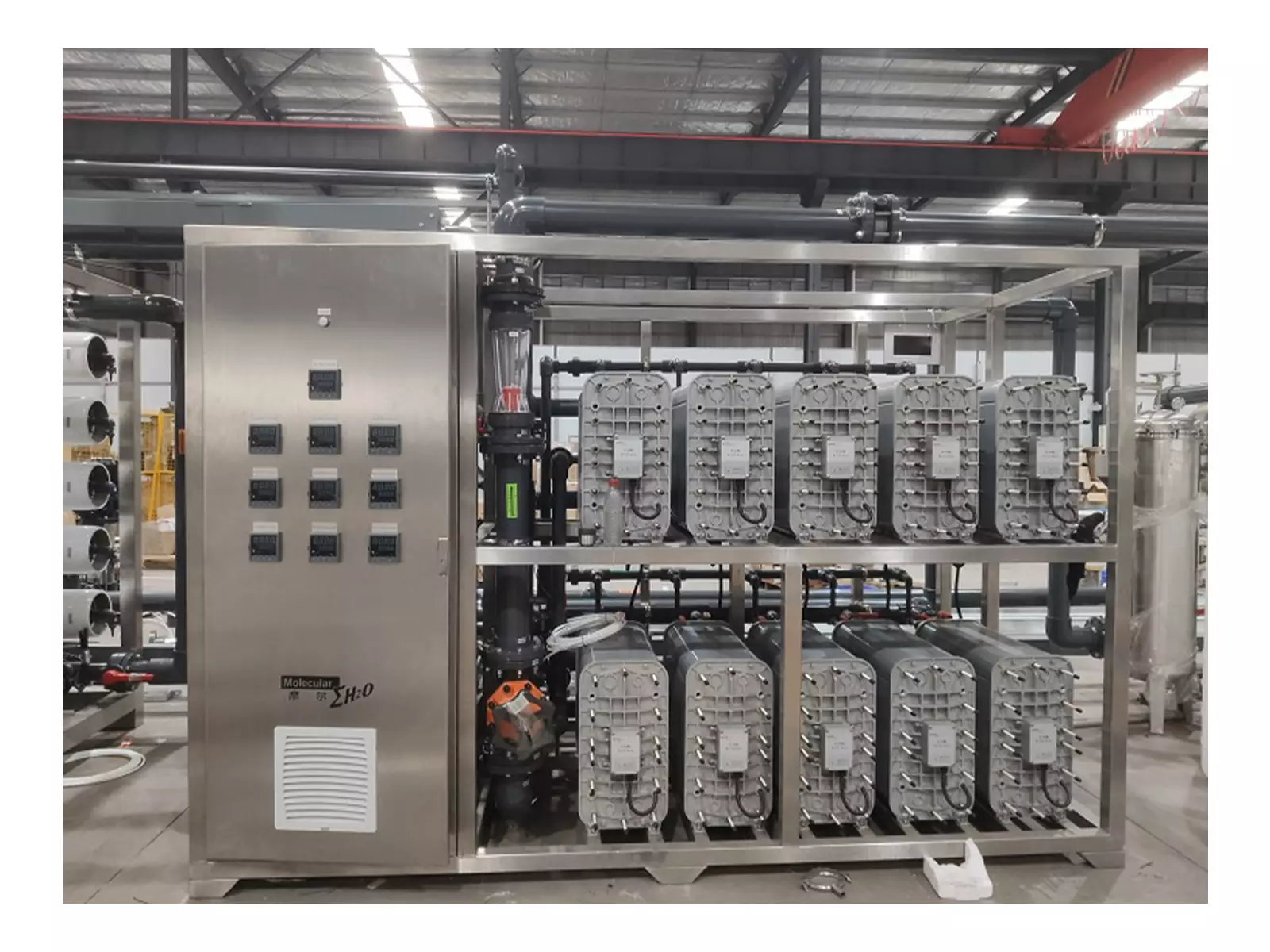
For industries and laboratories requiring consistent, extreme-purity water (such as microelectronics, pharmaceuticals, or advanced life sciences research),
Molewater’s Ultrapure Water System is an excellent choice, as it delivers reliable, 18.2 MΩ·cm ultrapure water tailored to meet strict purity standards.



 Portuguese (Brazil)
 English
 Arabic
 French
 Spanish
 Portuguese
 Deutsch
 Turkish
 Dutch
Dutch
 Italiano
 Russian
 Romaian
 Greek
Greek