


How Do I Choose the Right FOAOM for My Application?
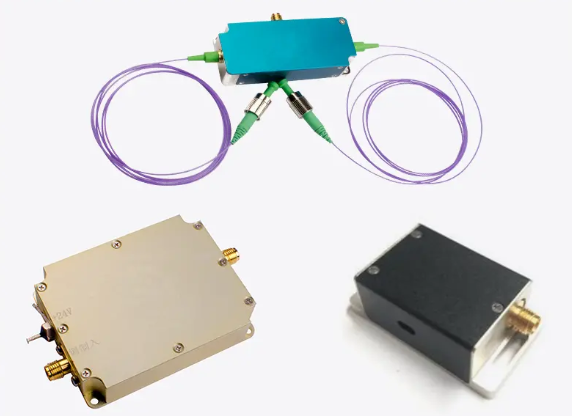
Choosing the right Fiber Optic Acousto-optic Modulator (FOAOM) for your application requires a multi-step approach, considering both the functionality you need and the technical specifications of the FOAOM itself. Here's a detailed breakdown to guide you through the selection process:
Step 1: Define Your Application Needs
Here are some common applications:
l Amplitude Modulation: Modulating the intensity of a light signal to carry information.
l Pulse Picking: Selecting specific pulses from a continuous stream emitted by a laser.
l Frequency Shifting: Slightly altering the frequency of light for applications like sensing or spectroscopy.
l Q-switching: Rapidly switching a fiber laser cavity between high and low-gain states for generating short, high-power pulses.
l Laser Beam Deflection: Steering the direction of the laser beam for applications like displays or optical switching.
l Laser Source: Identify the operating wavelength of your laser source. The FOAOM's operating wavelength range must be compatible with your laser (common options: 1064nm, 1310nm, 1550nm).
Modulation Requirements:
l Bandwidth: Determine the bandwidth of your signal, which is the range of frequencies it carries. The FOAOM's bandwidth needs to be greater than or equal to your signal's bandwidth for proper operation.
l Speed: Consider the required speed of light intensity control or switching. This is influenced by the rise time and fall time specifications of the FOAOM (faster times for high-speed modulation).
Step 2: Evaluate Key FOAOM Specifications
Now that you understand your application needs, delve into the technical specifications of the FOAOM:
l Operating Wavelength Range: As mentioned earlier, ensure compatibility with your laser source.
l Insertion Loss (dB): This represents the amount of light power lost when passing through the FOAOM. Lower insertion loss indicates better efficiency (prioritize lower dB values).
l Extinction Ratio (dB): This describes the contrast between the 'on' state (light transmitted) and 'off' state (light blocked). A higher extinction ratio signifies a more complete shutoff of light in the 'off' state, which might be crucial for your application.
l Rise Time and Fall Time (ns): These represent the speed at which the FOAOM switches between 'on' and 'off' states. Faster rise and fall times are necessary for high-speed modulation applications where rapid switching is required.
l RF Power Handling (W): This specifies the amount of radio frequency (RF) power required to drive the FOAOM and achieve the desired modulation. Choose an FOAOM compatible with your RF driver's output power.
l RF Frequency (MHz): This defines the operating frequency of the RF signal used to control the FOAOM. The modulator's design dictates this frequency, and it often needs to be matched with an RF driver for optimal performance.
l Bandwidth (MHz): As discussed earlier, the FOAOM's bandwidth should exceed your signal's modulation bandwidth to ensure proper modulation across the entire frequency range.
Step 3: Consider Additional Factors
Beyond the core specifications, some additional factors may influence your choice depending on your specific application:
l Operating Temperature Range: Select an FOAOM suited for the temperature range your system will experience. Extreme temperatures can affect performance.
l Package Size: Consider space constraints within your system. FOAOMs come in various sizes, so choose one that fits your available space.
l Environmental Stability: If your system will be exposed to vibrations, humidity, or other harsh conditions, choose an FOAOM with appropriate environmental stability.
Step 4: Consult with Manufacturers or Distributors
Once you have narrowed down your options based on the above steps, it's recommended to consult with FOAOM manufacturers or distributors. Here's how they can assist you:
l Discuss Specific Needs: Explain your application's requirements and get recommendations based on their product offerings.
l Technical Guidance: They can provide in-depth technical specifications and answer any questions you may have about specific FOAOM models.
l Application Notes: Manufacturers often offer application notes or design guides that provide valuable insights into using FOAOMs in various scenarios.
By following these steps and carefully evaluating the FOAOM's specifications in relation to your application's needs, you can make an informed decision and choose the most suitable Fiber Optic Acousto-optic Modulator for your project.
 Romaian
 English
 Arabic
 French
 Spanish
 Portuguese
 Deutsch
 Turkish
 Dutch
Dutch
 Italiano
 Russian
 Portuguese (Brazil)
 Greek
Greek